Too many advertisers are rushing to activate across retail media without paying proper attention to how they are set up, leaving them missing out on greater returns. Here are the three considerations that are the most important to get right before you begin activating your retail media.

If your first party data tracking isn’t up to scratch, your conversion efforts will be weaker

Every retail media engine operates by pulling in conversion data based on how your first party data tracking is set up. These signals need to relay back to the engine correctly to make sure that your key metrics are tracked and attributed properly. Retail media systems update their algorithm based on historical data and how likely it is a customer will convert. If these signals aren’t up to scratch, you will be feeding false logic into the funnel and hampering conversions.

The same goes for how your media agency can optimise your retail media in real time, we need a single source of data that we can trust.

Your product feed should give the most accurate representation of your products

Once you know you have the right tracking in place, the next important element to crack is your product feed. Taking Google’s Merchant Centre or PMax as an example, if you have uncategorised products and inaccurate accompanying product information then these engines will be reasoning from the misclassification of your feed. Ill-performing retail media placements aren’t random; they are based on the information (or lack of information) you have provided.

The easiest way to illustrate this is to consider if one of your products is a red, zip-up jacket and you’ve categorised it simply as a ‘coat’ then your product isn’t going to appear when those high-intent shoppers are searching for a red jacket. Cleaning up your feed allows retail media algorithms to work in unison with your sales, rather than against them.

Retail media should optimise towards profit, not sales

Like any other channel, measurement is incredibly important in retail media. It’s not enough to make revenue gains from product sales. We need to consider every element that can affect sales: retail ad fees, manufacturing costs, shipping fees, sale prices, returns & warranties and product competition. Without a view on this, you are only seeing half the measurement picture and are at an increased risk of profit loss.

The strongest retail media strategy will focus on profit as a growth driver, not sales.

There’s no doubt that there are many exciting opportunities in retail media. To make the most of them, you must ensure that your first party tracking, product feed and measurement frameworks are setting you up for success. The impact of taking these steps can be phenomenal. It’s an approach we took with the retailer JML and within three months we delivered an 825% increase in profits compared to the same period in the previous year.


If you want to find out if you are set up for retail media success, get in touch.

When we have a full understanding of the direction that a client’s media needs to take, we begin engaging with relevant media owners that can support our objectives. From their ability to drive effective reach and target different audiences to using the right tactics to drive engagement, attention and the desired call to action; our partnerships with media owners ensure we can measure effectiveness, maximise value and deliver a connected customer experience.

In this Media Innovation series, we speak with some of our partners from across the advertising industry to uncover everything there is to know about their channel. Click here to sign up to be alerted when the next in our Media Innovation series is published.

Media Innovation: Retail Media

Retail Media refers to the digital advertising space, retail data assets and in-store opportunities a retailer or marketplace owns, which brands can use to execute their advertising campaigns. The IAB has forecasted that online retail media advertising spend will exceed traditional linear TV ad spend by 2026 to reach €25bn. For the first in our Media Innovation series, we sat down with Skai’s executive vice president, David Sequeira to find out how media agencies can get the most out of retail media for their clients. 

What is the one thing you wish everyone knew about retail media? 

Retail media isn’t just another media channel. It’s the closest thing we’ve ever had to real consumer intent. The teams that run retail media and commerce operations are all starting to become one, blurring the line between commerce and media. Retail media links supply chain, shopper behaviour, media investment and sales in a single loop. This means that advertisers need to look beyond how they’re optimising bids & budgets and consider other signals such as digital shelf metrics. For example, if you can see that a product is low in stock, you will want to make sure that bidding is pulled back so you’re not paying high rates for a product that doesn’t have much more opportunity to sell.  

The brands that win won’t treat retail media as a budget line; they use it to uncover business insights for growth. The moment people see it that way, the entire conversation becomes more strategic. 


What’s the biggest misconception advertisers have about retail media? 

People assume that it’s easy. That you plug in spend and magic happens. In reality, every retailer behaves differently. The data is fragmented, as are the teams within media agencies that plan and buy retail media. 

If you consider retail media in Europe as an example, you have over forty countries, each with their own collection of retailers. In the UK, we have the big six grocers plus Amazon, all operating separately. It becomes even further fragmented when you look at the structure within media agencies where retail media is planned and bought by disparate teams. Many agencies have teams that focus purely on Amazon, with other retailers dealt with completely separately. This leads to teams fighting internally for budget, with no real view on how to spend budget most effectively across all retailers. 

This challenge is underscored by the misconception that retail media is a lower funnel, tactical decision. Historically, it’s been treated like search, for brands trying to make a sale. Today it’s becoming full funnel. Take Amazon as an example. It encompasses CTV and subscriptions with Amazon Prime, then has Amazon DSP plus sponsored brand and product opportunities. Advertisers and agencies must consider retail media holistically and better organise their agencies to get the most from it. It can’t be a TV team, a search team and DSP team each buying Amazon separately, it must be joined up. Once advertisers and their agencies realise this, their performance will be transformed. 

What are the questions you’re most often asked by advertisers? 

There are two main questions advertisers have asked me over the last year: 

“How do I measure retail media consistently?”

Measurement is the biggest thing in retail media that we’re being questioned about. Everyone wants a unified, comparable view across all retailers. From there, they want to understand how it’s effecting real sales. Incrementality is becoming a huge topic for us. Advertisers want to prove the value of retail media and measure it consistently. This is where tools like Skai and our Databox solution matter. 

“How do I scale globally?

Advertisers are operating across a messy retailer universe with no standardisation. Advertisers without a tech partner to bring everything together in one place face a huge challenge. For every big CPG advertiser I speak to, the questions come down to: how many retailers have you got? How many can you bring in? Can we see it all in one place? They want a unified way of planning, buying and measuring retail media globally.  


If you could change one thing in the industry, what would it be? 

Specific to retail media: fragmentation. Every retailer has their own taxonomy, reporting style and measurement framework. It slows brands down, it slows agencies down and it slows retailers down. 

If we could standardise the basics, everyone could focus on driving value instead of translation work. And while we’re at it… one login for all retailer platforms wouldn’t hurt, that’s where Skai comes in, (shameless plug)!  


What’s the best use of retail media you’ve seen in the past three months? 

The best work I’ve seen recently is from brands that combine retail media data with upper-funnel insight. They’re not creating flashy, one-off campaigns, but are building real momentum between insight, activation and measurement. These brands are outperforming quarter after quarter because they’re consistent, not reactive.

What are you most passionate about achieving this year in media? 

This year, beyond commercial goals, I’m passionate about pushing the conversation around neurodiversity in our industry.  

I have two autistic sons and watching how they navigate the world has reshaped how I think about workplaces. So many people in media are ‘masking’; holding it together, managing sensory overload or social pressure, just to get through the day. 

If we can build environments where people don’t have to hide who they are to succeed, the work improves and the culture improves. Creativity comes from cognitive diversity. For me, making the industry more inclusive and more human is just as important as any media trend. 


How can media agencies get the most out of retail media for their clients? 

There’s a real opportunity to be had in stopping firefighting and wasting time on how agencies and brands are set up operationally to instead start strategizing again.  

For me there are three things that agencies must focus on in retail media: 

  1. Lean into AI – Focus less time on tasks that can be automated, and more time on delivering client value. Agencies (and brands) that use agentic AI for insight, planning and optimisation will move faster and deliver more strategic value.
  2. Own the operating model – The retail media landscape is developing and changing so quickly that most CPGs and agencies are still figuring out their operating structures. It’s crucial for agencies to work with their external partners to connect the dots, align their technologies and bring everything together across retail media and commerce operations.
  3. Use data as the connective thread – This is linked to connectivity. Agencies shouldn’t treat each retailer as a silo. Instead, they must find smart ways of using data to unify retailers so brands can plan properly. Brands are going to demand to see incrementality and business impact, not vanity metrics like ROAS. Yes, brands will pay their agencies for what they do, but increasingly, they’re going to pay for the performance they deliver and the guidance they can give them on how to spend their next pound to sell more. 

The agencies that do these three things will become indispensable partners. 

Click here to sign up to be alerted when the next in our Media Innovation series is published.

Skai is the world’s leading omnichannel platform unifying retail, search and social advertising with its AI-powered commerce media platform. 

This month’s day in the life is with digital account director, Rianne Clarey. In our chat, Rianne tells us how a fascination with left and right-brain thinking led her to a career in the media industry and why you should never assume that anyone you encounter at work knows anything or everything!

What led you to a career in media?

Left and right-brain thinking has always interested me, but I never thought that I was either super creative or super analytical. Media & advertising is an industry that allows you to combine the two. Initially, I wanted to be a graphic designer within the advertising industry. Then at school my friend got me a two-week work placement at her uncle’s creative agency and I fell in love with the work. After that, whenever I had any spare time in my college years, I would head back to Regent Street and continue my work experience there. 

After completing a degree in advertising, I had the panic realisation that I needed a job, quickly! I applied for everything I could within the industry which is how I came to working in digital teams in agencies. During my first interview they were throwing acronyms at me from every angle. Even though I didn’t know what CPM or CPAs were at the time, I got the job! Having joined the agency’s affiliate team, I started to hear about interesting work going on in the paid social teams. I offered my time to help them out wherever I could until, eventually, I was able to make the move across to paid social.  

From there I joined a multi-channel agency where I discovered that I love data. I enjoy being able to analyse the effects that our media decisions have had on a business. Since then, I’ve specialised in search and social across different media agencies.   

What does a typical day look like for you?

There’s a real balance in my days throughout the week. Working from home on Mondays and Fridays are really when I get deskwork done, catching up on emails and working through reports. When we get into the office on Tuesday to Thursday, things are much more collaborative where I can catch up with the team and speak to clients. 

On the days at home, I get my head down and focus on new strategies and proposals, considering how we can optimise campaigns. Alongside my day-to-day work, I think it’s so important to keep up with market trends and learn something new. It makes it more existing for us as a team, but just as importantly it’s how brands grow and how we grow as an agency.  

What is your most memorable moment at MI?

Its still early days (I’m only in month four!) but it’s been about coming in and quickly learning about how the agency works and what the clients I’m working on want to achieve. What has really stood out to me in this time is how my team has eased my transition into the agency. Hopefully my clients can see that reflected in the relationships I’ve already begun to build!

What advice would you give to someone looking to become a digital account director?

When you become a digital account director, and even while you’re developing at the manager level, your work is no longer task driven. It’s about thinking beyond a given set of tasks and creating your own workflowYou’re always looking for the next opportunity. You must increase your business savvy and ask of everything: is this idea profitable for both our client and our agency? It’s about having those broader ways of thinking instead of the tunnel vision of just managing your own work and ticking off your to do list.

What mistake have you learnt the most from?

One lesson that has always stuck with me is to never assume other people’s knowledge. In my earlier years as an executive and a manager, I had a habit of overcomplicating things to get my point across. I believed that everyone needed to know every inch of detail, when in fact this would confuse the client. 

Clarity is key, don’t feel idiotic about really spelling things out. Even if you think your team or your client already knows something, they might not. This applies equally to presentations: the simpler the better. Never assume that anyone knows anything or everything! 

Who’s your role model and why?

Even though he’s not media related, I would say my brotherAfter an error with a vaccination before a family holiday to Egypt, he developed a condition called CIDP which is a form of MS. Throughout his life he’s always been really sporty. My dad was a rugby coach at the time and my brother always played; with CIDP he thought he would have to stop playing. However, even when things were looking quite bad for him, he never gave up. He always strived for better and never let anything get in his way. He’s very inspirational and I really look up to him for that. 

At MI we accelerate growth for challenger brands, working collaboratively with our clients to deliver immediate impact and sustainable growth. This concept is not new, but it’s highly effective when executed well. We see it exemplified by leading brands every day. Our team is always on the lookout for the latest inspiration from innovative brands, agencies and media owners adopting the “accelerate growth” concept. We wanted to share some of the lessons we’ve learnt from brands along the way.

Marketing Insight

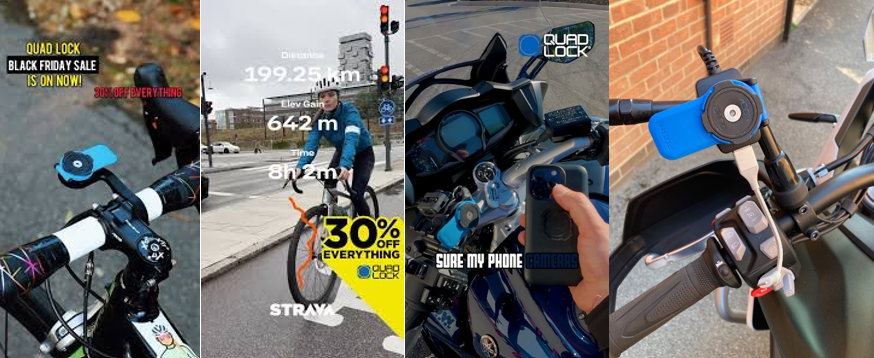
Like many of the best ideas, Quad Lock was born as a solution to a problem. Chris Peters, an industrial designer and avid cyclist, needed a secure way to mount an early iPhone to his bike. Finding no solution in-market, Peters and co-founder Rob Ward developed a case-based mount system featuring a unique twist-lock mechanism (with a distinctive blue locking tab). This became the first Quad Lock bike mount, launched via Kickstarter in 2011.

The product gained traction, establishing Quad Lock’s name among cyclists globally. Feedback showed that motorcyclists were repurposing the bike mount, so Quad Lock adapted its design and started marketing to motorbike riders just two years after launching. From two wheels, the company introduced mounts for cars, running and everyday use; turning Quad Lock into a multi-activity brand rather than a single-use gadget. Each new product was tailored to the user’s needs but centred on the same original locking mechanism and investment in robust design and materials.

Media Innovation

Quad Lock was an early adopter of direct-to-consumer ecommerce. By launching on Kickstarter and fulfilling orders worldwide through its website, the founders made the business global from day one. The crowd-sourced launch generated advocates quickly and the brand gained popularity & organic growth through cycling forums and groups.

Quad Lock embraced performance marketing and social media. The brand invested heavily Facebook, Instagram & Google Ads and was an early adopter of TikTok’s Value-Based Optimisation. It also relied heavily on first party data to fuel insights and proactively push out cross-selling & bundles to relevant audiences.

Quad Lock has always been creatively consistent. Good design has been a mainstay of the Quad Lock journey and its messaging has always centred on its security, durability and reliability. No fads or gimmicks, instead letting the product do the talking to relevant audiences.

In a social space, ads alone would not fuel growth. Quad Lock was an early adopter of content marketing, creating how-to videos, product demonstration clips and allowing user reviews and photos to speak for the product. This user-generated content and social proof were critical in building trust online but also became part of the brand’s e-commerce strategy. Quad Lock secured affiliate partnerships with these content creators, bridging the gap between creator content and paid advertising.

As the brand has grown, Quad Lock has further expanded its influencer marketing, using local influencer across over 100 markets to ‘localise’ its brand presence. This global reach has allowed it to tap into more high-profile ambassadors, from cycling and Motorcross to Formula1. The connections with two-wheeled sports retain that connection with the brand’s roots, whilst its McLaren F1 partnerships aligns with its expanding motoring range and introduced collaboration and merchandising opportunities.

Within these activations there’s always a clear path back to a product and a purchase journey, but these softer activations serve multiple purposes. They enable the brand to reach new audiences while reinforcing Quad Lock’s brand identity and staying relevant to its growing (direct) customer base, making customers more likely to remain loyal at their next phone upgrade. In a world where the average adult spends around three hours a day with an £800 piece of tech in their hand, Quad Lock has built a loyal customer base of millions of users globally who are locked in to also upgrading their cases every two to three years!

Media Innovation

Accelerating Growth

Quad Lock solved a problem and sold the solution to the right audience in the right way. It removed barriers to purchase from day one, but understood that reputation and trust were key to driving growth. Global growth doesn’t have to be driven by multi-million-pound TV campaigns, but it’s not driven by ecommerce alone either. Solving a consumer problem and being true and authentic to your proposition will always yield the best results.

Quad Lock has built a base of millions of loyal customers, of which 75% come directly to the brand. From a $35,000 Kickstarter in 2011, Quad Lock grew to $196m in sales in 2024.

It may not be the sexiest product, but any brand that has grown as consistently while staying true to its vision (and achieving a $500m acquisition in the meantime) gets my vote for an Accelerate Growth journey.

Marketing Insight

Stanley has been providing top quality Tupperware and drinkware since 1913. Trusted by hikers and workers, the brand had a reputation for being practical and long lasting. As a $70m a year business that had survived for over a hundred years, it would be considered very successful by most people.

Whilst the cup is undeniably well designed (as a proud owner myself, I can vouch for that personally), design alone wouldn’t have given it the global status it now has. The rise of the Stanley Cup was timed perfectly with the growth of the multi-million-pound wellness industry. Exercise, fashion and, importantly, hydration were all becoming intertwined. Just like the 10,000 steps a day trope seeded in the public imagination by a pedometer company, Stanley was primed to jump on the global trend of people obsessed with getting their two litres a day.

Media Innovation

The recent Stanley boom can be traced back to the Quencher – a water bottle designed to fit in a car cup holder, be dishwasher-proof and keep drinks cold for days. However, when it launched in 2016, sales faded out like a match in a storm. By 2019, the company had made the decision to stop manufacturing them altogether. This was until a desperate plea came from Ashlee LeSueur, a personal fan of the cup and founder of The Buying Guide, who begged Stanley to continue selling Quenchers. Upon discovering ‘Stanley Cups’, she had begun gifting them to her friends, who adored them and believed they could be huge commercially. Stanley asked LeSueur to commit to a large a wholesale order if she wanted them to continue making the Quencher. Deciding to take the risk, she put in a substantial order and began re-selling them to her audience through The Buying Guide. This was far removed from Stanley’s traditional audience – the practical outdoor adventurers. LeSueur’s audience was a female, fashion and health-conscious audience. The risk paid off and so Stanley was persuaded to continue manufacturing the cup, re-launching it to a new audience and unlocking a whole new potential for business growth.

Taking lessons from its affiliate marketing partnership with The Buying Guide, Stanley recognised the opportunity to reach new audiences that both influencer marketing and social media represented. It partnered with TikTok creators and tastemakers to tap into their inspirational lifestyles and make its product synonymous with the rising wellness aesthetic. What happened next couldn’t have been predicted: when a woman’s car caught on fire, her Stanley cup survived – with the ice still in it. The moment went viral, reaching over 10 million views. Stanley was quick to react, with its President saying they would send her more Stanley cups and replace her car. The brand further capitalised on this community-led moment by using paid social to amplify the story. Having already begun to build brand buzz across social, this moment both validated the cup’s quality while also building brand trust.

Accelerating Growth

With over 100 colour ways and the constant launch of new collaborations the Stanley Cup craze shows no signs of abating. Cut to today and Stanley continues to be plastered across TikTok and, thanks to the cross-bottle ‘handsfree hydration’ range launch, worn with pride IRL.

The Quencher, now more well-known as the Stanley Cup, remains the brand’s best-seller. But, by becoming synonymous with this one product, Stanley has become a household brand with sales across the whole range benefitting as a result. From a business that was bringing in $70m a year, Stanley reached a remarkable $750m valuation in 2023.

We’re delighted that our work with SME business insurer Simply Business has won Bronze in the TV / CTV category at The Drum Awards for Media.

The TV / CTV category rewards campaigns that leverage television, connected TV (CTV), cinema and streaming platforms to deliver impactful marketing messages and engage audiences across traditional and digital environments. The winning campaigns demonstrate how these channels were strategically integrated to maximize reach, enhance targeting capabilities and engage the target audience. 

When it comes to our entry for Simply Business, it’s no secret that the insurance market is a crowded space. From opera singers and iconic meerkats, standing out isn’t easy. It takes something special to make people sit up and take notice. Simply Business set about doing just that. It had historically relied on generic PPC search and price comparison websites to drive business but recognised an opportunity to grow the number of direct customers. We needed to increase awareness and consideration for Simply Business, ultimately leading to more customers buying direct.

Truant’s creative concept centres around a memorable play on Tina Turner’s 1980s hit ‘The Best’ which captures the feeling of knowing your business is protected. Our media strategy used contextual advertising, placing Simply Business’ ad alongside TV programming that showed the euphoria of success. During a summer of sport, we secured access to premium live events, including the Premier League’s opening game and Paralympics Opening Ceremony. This was supported by spots across what we termed ‘skilled reality’ programming: reality shows that feature an element of competition.

The results of our approach were quite simply… the best! Simply Business has grown to record highs in both awareness and consideration. As of August 2025, the campaign has delivered a 50% and 28% increase in spontaneous and prompted awareness respectively, while consideration levels have increased by 18%. These improvements in brand health are reflected in the Simply Business journey, as branded search has increased by 52%, resulting in a +22% YoY growth in policies sold via brand search.

To read about this campaign in more detail head to our case study page. To see the full awards results, head to The Drum Awards page.

ActionAid UK, the international charity working to achieve social justice, gender equality and poverty eradication, this week launches its bold new fundraising campaign, Side by Side, which champions the inspiring women rebuilding their lives after crisis.

Amid rising anti-refugee rhetoric both in the UK and abroad, the campaign calls on viewers to “stand with women across borders, side by side” by committing to a regular donation that helps displaced women establish new livelihoods.

After two years off air, ActionAid UK returns to TV with a powerful message that centres the authentic experiences of women, amplifying their voices as they tell their own stories in their own words.

The number of forcibly displaced people has almost doubled over the last two decades, standing at one in 67 people globally, according to UNHCR – with women and girls among those most at risk.

ActionAid UK partners with women-led groups who work alongside women refugees, helping them to rebuild their lives with dignity and strength, as well as support other women.

The Side by Side film highlights the compelling stories of two remarkable women:

  • Gloria, who fled conflict in the Democratic Republic of Congo and found refuge in Uganda, where she trained as a tailor and now inspires other women to do the same.
  • Leokadia, who escaped the war in Ukraine and found safety in Poland, where she set up a cooking academy to help other refugee women earn an income.

Their stories demonstrate how regular donations to ActionAid empowers women to take control of their futures, support their families and strengthen their communities.

The campaign will run across national TV, with media planning and buying managed by MI Media.

Sabina Basi, Funding Director, at ActionAid UK, said: “At ActionAid, we believe that all women – anywhere in the world – deserve a life of dignity and hope. Side by Side celebrates women’s resilience and leadership, as well as the tangible impact they make to their communities — and calls on all of us to stand with them in solidarity, not as victims of crisis, but as agents of change.”


You can read about media partnerships we’ve developed for ActionAid here and here.

This month’s day in the life is with our finance director, Jerome Charles. In our chat, Jerome speaks to us about the route he took into finance within the advertising industry and how what you see as mistakes changes as your career evolves.

What led you to a career in finance?

I was good at numbers throughout school and a maths degree followed which led me into a career in sales. Unfortunately, while I liked the idea of it, it turned out I wasn’t particularly good at sales. When a job opened up in the accounts department at the same company it was a no brainer, I jumped at the opportunity. Accounting felt so much more comfortable to me. I am far happier looking at a spreadsheet rather than writing a speech or presenting a deck.

That first role was in a company selling knowledge on the property overseas market. After the 2008 recession, the company went through a tricky time and, even though I was still junior, I became the sole person on the finance team. I left to go travelling and when I returned, after a finance role in theatre turned out to be surprisingly corporate, I was offered a role in the media industry. It was an eye opener into a much more interesting industry for me in a far more relaxed environment. I was also lucky to begin working under a great finance director who I followed to subsequent roles.

What does a typical day look like for you?

One of the beauties of finance is that there are specific deliverables which give your days and weeks structure. In my role as finance director, I must strike the right balance between the strategic: planning, forecasting and performance, and the supportive: making sure that every stakeholder in the business has what they need to do their jobs. A huge part of my role is supporting my team and the SLT with their work, I have to manage that while bringing a strategic financial perspective across different areas of the business.

What is your proudest moment at MI?

I was brought into MI to take the finance team from what was needed as a small enterprise, to what is needed within a medium sized enterprise. This involved making things system-based and automated, taking the finance function up to the next level. I achieved that by upskilling our current team, bringing in new software and developing new custom-made software which has automated our processes. All of this has enabled our team to deliver financial information faster.

That whole journey has been a proud moment. Thinking of where the finance function was when I started to where it is now is something I draw a lot of pride from.

What advice would you give to someone looking to become a finance director?

For anyone working in accounts that has ambitions of becoming a finance director I would say that getting to know the business is fundamental when taking a step up. It’s not just about understanding your P&L and the balance sheet, it’s about getting to know the story behind it. Understand your company’s culture, the industry, the clients and whatever products or services you are selling. As a finance director, you’re always looking at opportunities and risks. What are the next steps to get the business to the next level, whether that’s profitability, growth or any other metric. You need to understand your industry well to know what decisions to make to move those dials.

You should also develop your commercial acumen and communication style as much as possible. One of the biggest aspects of being a finance director is explaining complex finances to people that don’t sit in that world. Being able to communicate clearly and effectively will really help you excel in your role.

What mistake have you learnt the most from?

As you progress through your career ladder, I think what you see as mistakes changes. I remember earlier on in my career I would have said that accuracy is king. When the primary part of job is transactional then you want to be as accurate as possible. As your career develops you begin to understand that trying to be too accurate can in itself be a mistake. As an FD, you shouldn’t be aiming for everything to be perfect before broaching an idea. It’s far quicker and more effective to develop your ideas until they’re 90-95% there, then open them out to collaboration with your MD and senior leadership team to get them over the line. It’s a mistake for any FD to put the responsibility for anything solely on themselves.

Who’s your role model and why?

My old FD who I have worked with a couple of times over the years, Sukhdev Poonian, was fantastic. We worked together for six or seven years and in that time, he took me from being a quite green in junior accounting to a senior management level. What was nice about our relationship was that while I was on that journey, he had a massive impact on me in terms of technical capability, but I also had an impact on him too as he became a much more extroverted and confident FD. We worked incredibly well together and took a lot from each other. I really enjoyed seeing him grow into both a well-rounded and button-tight, technical accountant while also working on his commercial and personal side. Seeing that example of someone senior that was still developing who they were as a professional has stayed with me throughout my career.

This week we launched a powerful new fundraising TV advert with international humanitarian organisation, Médecins Sans Frontières (MSF). The campaign highlights what it means to donate by reinforcing the life-saving impact of regular giving.

The campaign, created by krow Group, is a bold step forward for the charity’s communications, bringing donors inside the action. With the aim of increasing monthly donations, the ad highlights the importance of donations, and how they directly impact MSF’s ability to deliver long term, independent medical aid in areas affected by conflict, disaster and disease. The ad will run across TV, VOD and Social as part of MSF’s wider Winter Campaign, in rotation with ‘The Life Saving Moment’ ad, launched in October.

Amid an overwhelming backdrop of global crises, ‘Part of the Team’ invites viewers to see themselves not as passive bystanders, but active participants. The emotionally charged film transports a donor from her living room into MSF’s world.  It places them inside an MSF frontline operating theatre, shoulder to shoulder with medical staff, to feel the urgency, witness the stakes and experience what it means to play a vital role – not as a bystander, but as part of the team.

Told through a minimalist, spot lit visual language and using sound to seamlessly transition the donor between the comfort of home and the urgency of the frontline. It captures both the emotional weight and the importance of MSF’s work. The message is simple but powerful ‘Stand with Us’.

Michaela Campion-Smith, Acquisition and Emergency Fundraising Lead at Médecins Sans Frontières said, “We know people want to help during times of crisis but often feel disconnected from the impact they can have. This film bridges that gap, showing that when someone donates, they’re not just giving money, they’re stepping into the story, becoming part of the team that saves lives.”

You can read about how we increased MSF’s donations by 50% YoY with last year’s winter appeal here.

Following the launch of OpenAI’s TV campaign, business director Annabelle Sitwell spoke to The Media Leader about how this move follows in the footsteps of many other tech giants before it.

It feels like OpenAI has broken its own fourth wall, stepping outside of its virtual world and into a world that it’s had us believe was nothing but a distant memory… linear TV.

Whilst much has been made of OpenAI’s move into TV, it seems to me that this was the logical next step. Fellow tech giant Google has always run high-budget, emotion-led traditional media advertising. Its TV ads focus on the humanity behind the searches and it’s often leant heavily into OOH to showcase its live data feeds with hyper-localised weather or traffic data.

Digital channels bring early adopters, traditional advertising deliver mainstream reach

This is the natural progression of a tech product launch. Using digital channels in the first instance to get early adopters onto the platform whilst every element is going through beta enables the team to optimise processes like product features, UX and pricing strategy. It’s important to remember that ChatGPT is likely still in its relative infancy – even though we’re already on v5! According to itself, it was first launched in 2018, but it was the 2020 version that garnered global attention. In a world where engineers need real usage data to optimise and roadmap new features, managing a gentle but steady growth curve is best. It’s important to remember how slow and often inaccurate the early versions were. Large uptake wasn’t an option. However, with all future-facing products natural growth will plateau (the same was seen with electric cars). And with large investment rounds it needs to gear up for the next level. This is the moment when brand campaigns across trusted advertising channels will deliver the mainstream reach these platforms need to become universally used.

ChatGPT thinks its own ads risk being too subtle

Interestingly, when I asked ChatGPT what it thinks about its own ad, it thinks there’s room for improvement. It’s thrilled with its own emotional arc and that it’s re-enforcing that it was directed and filmed by humans. But it thinks it risks being too subtle, leaving people wondering what ChatGPT is for. To quote, “some viewers might watch without really understanding why the tool is valuable beyond a vague ‘helpful assistant’.” Clearly, it’s worried that some people will miss underestimate its true value!

Accelerated growth for OpenAI and ChatGPT must come from winning over a more cautious audience with a long-term goal of wearing down the sceptics. It makes perfect sense then that OpenAI would launch its first global brand campaign on the most trusted advertising medium: TV.

This article first appeared in The Media Leader.