
I went to Big Data LDN and, in a completely unexpected turn of events, everyone was talking about AI.

There wasn’t a huge amount that completely changed how I think about AI, but that was useful in itself. Across the sessions, I kept hearing variations of the same challenges businesses are already working through. How do you move beyond an interesting AI experiment and create something that delivers genuine value? How do you measure that value? And how do you get people to trust and actually use it?

My favourite session, Scaling AI for Business Impact: From Experimentation to Value, brought a lot of this together.


Start with the problem, not the AI

One of the clearest messages from the session was also one of the simplest: don’t start with the technology, start with the business problem. It sounds obvious, but with all the excitement around AI, it’s easy to start with what the technology can do and then look for somewhere to use it. A related question from the session was:

Do you want to improve what you’re doing and do it better, or completely change what you’re doing?

That distinction matters. Once the problem is clear, we still need to decide what role AI should play in solving it. Should it augment an existing process, automate part of it or enable us to rethink the process altogether?

Being clear about that from the beginning shapes how we think about value, adoption and the controls we need around it.
Getting something to work is only the beginning

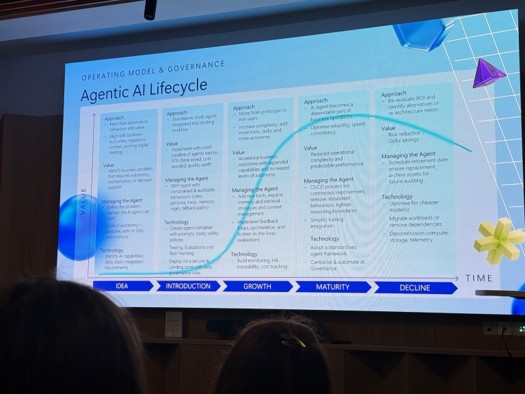
The session introduced an Agentic AI Lifecycle:

Idea → Introduction → Growth → Maturity → Decline

What I liked about the lifecycle was that it didn’t stop at adoption or maturity. The inclusion of decline is a useful reminder that value needs to keep being reassessed. Processes change, technology moves on and better options emerge. Something shouldn’t continue indefinitely just because it once worked.

The session also gave a good example of why getting beyond the pilot matters. One AI agent was consuming around 60,000 tokens for a single interaction. The speaker compared that with roughly 20,000 tokens for a master’s thesis, so each interaction was effectively processing the equivalent of three dissertations. Technically it worked, but whether that approach made sense at scale was a different question.

That resonated because we’d encountered a similar challenge ourselves. Earlier in the year, we experimented with conversational analytics, allowing people to ask questions of data more naturally and then explore the answers through follow-up questions. It worked and showed the potential, but the challenge was scaling it. At the time, the value didn’t justify the cost at scale, so we started exploring alternative approaches that could achieve the same goal more efficiently.

What was interesting was seeing conversational and agentic analytics appear across several other sessions at Big Data LDN, particularly given the direction reporting and insight generation seems to be heading.

The direction still feels relevant, but our own experience reinforced an important distinction: a working AI solution isn’t necessarily a scalable one. The value it creates, what it costs to operate and whether that equation still makes sense as usage grows all matter.

Easier answers make judgement more important

The conversations around analytics also raised a broader point about the role people play as AI becomes more capable.

If asking a question and getting an initial answer becomes easier, the value increasingly moves towards understanding whether that answer actually makes sense. That requires good data underneath it, but also business knowledge, context and critical thinking. Someone still needs to know when to challenge an answer, what might be missing and which question is worth asking next.

The same applies more broadly to AI adoption. A technically good solution won’t get very far if people don’t understand it or trust it. We need to be clear about where AI is there to help, what remains a person’s responsibility and where human judgement is still required. That means culture and training aren’t side issues to solve after the technology is built. They’re part of whether it succeeds in the first place.


More autonomy needs stronger controls

Trust also links closely to governance, particularly as we move from AI that provides information towards AI that can take action.

One of the later sessions focused on governing AI agents and made an important distinction: telling an AI what it is allowed to do isn’t the same as actually controlling what it can do.

There’s a big difference between an assistant that can answer a question and an agent that can update a system, send a communication or trigger a workflow. As the level of autonomy increases, the controls around it need to increase too.

That doesn’t mean every use case needs a huge governance framework. The level of control should reflect the level of risk. Permissions, accountability, auditability and human approval become more important as we give AI the ability to do more.

What I came away with

I didn’t leave Big Data LDN thinking we’d been looking at AI in completely the wrong way. If anything, it reinforced many of the questions we’re already asking and gave me a few useful ways of thinking about them as we continue experimenting with AI across the business.

What problem are we solving? What does success look like? Should AI augment or automate? Will people trust it? Does it make sense at scale? And when should we change, replace or retire it?

The technology will keep changing, but those questions feel much more durable.

Getting AI to do something is becoming easier. The harder part is turning that capability into something valuable, scalable and trusted enough to become part of how the business works.

Talk To Us

Want to find out how you can accelerate growth? Drop us a line and our team will be in touch.

triangle
triangle